Carpet Cleaning Chemicals
Carpet Cleaning Chemicals in Nepal: A Practical Buyer’s Guide
Choose carpet cleaning chemicals in Nepal for spotting, extraction, low-moisture cleaning, odour control, and routine maintenance.
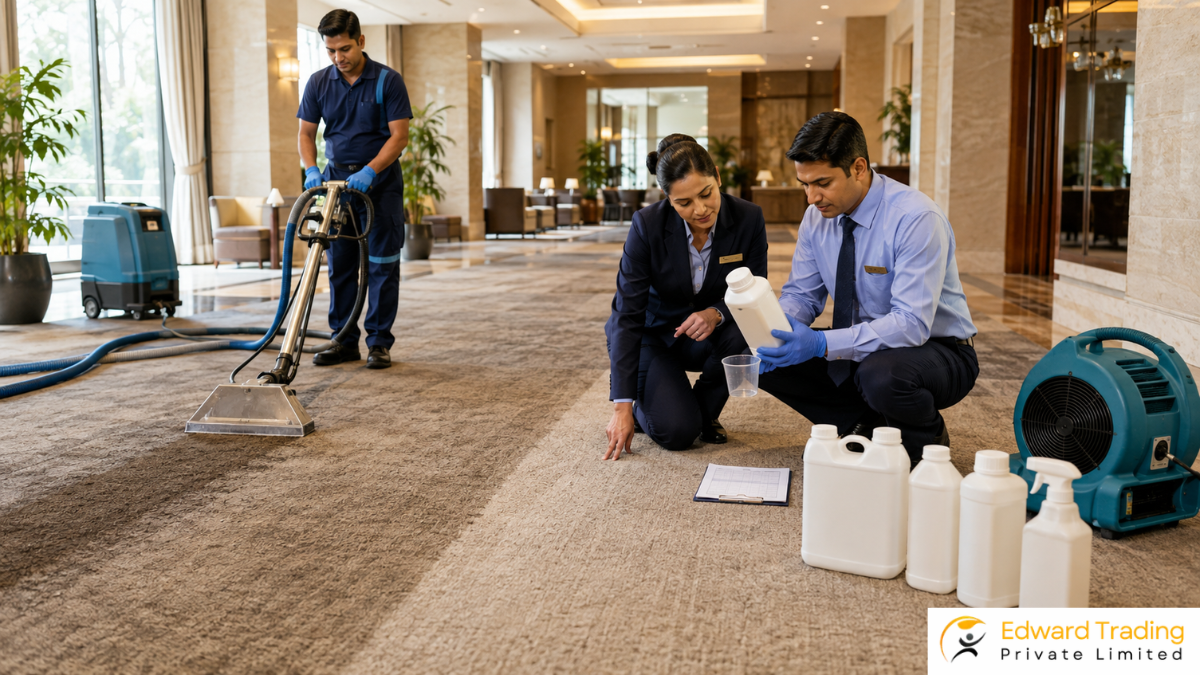
Carpet Cleaning Chemicals in Nepal: A Practical Buyer’s Guide
Carpet may seem fine from a distance and won't trap dust and grit, but will still trap oily soil deep between the fibres and spills. Thus, it is not just about selecting a strong detergent when it comes to the selection of Carpet Cleaning Chemicals in Nepal. Hotels, offices, cinema, schools, healthcare establishments and cleaners require a product that will work on a carpet, stain, machine and drying time.
In this blog, you will learn how to make that choice without ruining the carpet, leaving behind sticky residue or paying for carpet cleaning that could have been avoided.
Why carpet cleaning results often disappoint
Sadly, the majority of failures start before the machine is even powered on. The team might not be familiar with the fibre or backing, dry soil may not have been vacuumed thoroughly, or a previous spill might have been cleaned with an inadequate product. Staff sometimes overdose the detergent as they think they are getting more cleaning power as more foam is added. The carpet will then take longer to rinse, and will pick up dirt shortly after drying.
Buyers who are still defining the wider requirement can first review Edward Trading’s institutional supply solutions. This allows carpet maintenance to be incorporated into the overall cleaning and housekeeping program within the premise before a quotation is given.
Understand the job before choosing a carpet chemical
Check the carpet construction
Ask what type of carpet they are (wool, nylon, polypropylene, polyester, or combination) and if it is a broadloom carpet or modular tile. As important as the color of the pile, are the backing, adhesive, dye stability, and the manufacturer's care instructions. Products that work on a man-made carpet may not work on wool or on a carpet tile on a moisture sensitive adhesive. If there is uncertainty, test the product in an inconspicuous spot, and check the carpet once it has dried.
Identify what is actually making it dirty
These substances, such as dry grit, tea, coffee, cooking oil, mud, chewing gum, ink, and tracked-in traffic soil do not react the same way. Record the predominant soil type, its location, its age, and its uses. This information enables a supplier to recommend a routine cleaner, a pre-spray, a rinse cleaner, or the carpet spot remover to a customer for a particular spot stain problem instead of selling a product as a universal solution.
Match the chemistry to the cleaning method
The product needs to be compatible with the method used on site. Carpet extraction chemical is used in a process where the solution is applied and extracted in a machine. Low moisture or encapsulation cleaning works differently and is beneficial if a quicker drying time is critical. Bonnet cleaning can enhance the surface appearance between deep cleans, and should not be used as a replacement for embedded soil removal.
Choose the right product for each stage
A practical carpet-care programme usually uses several simple stages rather than one aggressive chemical. Not every site will need every product, but buyers should understand what role each one plays.
- Pre-treatment or pre-spray loosens heavy traffic-lane soil before extraction.
- Spot treatment targets a known stain with a product suited to that type of spill.
- Extraction detergent supports deeper cleaning when used at the stated dilution.
- Rinse or neutralising chemistry may help remove residues when the selected system requires it.
- Low-moisture products can support interim appearance maintenance where rapid drying is important.
- Deodourising products address odour only after the underlying source has been cleaned or removed.
When comparing carpet shampoo Nepal options, do not judge performance by foam or fragrance alone. Ask about the recommended dilution, intended cleaning method, fibre compatibility, rinsing requirement, expected residue, and drying conditions. A pleasant smell may improve the immediate impression, but it does not prove that embedded soil has been removed.
Edward Trading groups relevant products and equipment under its hygiene and housekeeping solutions. Use that page to understand the category, then confirm the exact product, pack size, application, and current availability directly.
How to compare products and quotations
Give every supplier the same requirement: carpeted area, carpet type if known, main stains, present method, machine model, cleaning frequency, drying limit, delivery location, and estimated quantity. Photographs can support an initial discussion, but they cannot replace a proper fibre and stain assessment.
Record the product, pack size, dilution, prepared volume, intended task, documents, lead time, and commercial terms. If an alternative is offered, ask why it is suitable. A concentrate and a ready-to-use commercial carpet cleaner Nepal option are not directly comparable when their method and cost per prepared litre differ.
Look at cost in use, not only container price
The cheapest bottle doesn't always represent the cheapest cleaning. Determine the amount of solution that can be prepared in the recommended dilution from the pack. Then take into account time spent on the labour, machine time, rinsing, drying, repeat passes, spot-treatment products and the potential for rapid re-soiling. If staff cannot accurately measure a concentrate and be consistent in its use, it will not be a good value.
Overdosing consumes stock quicker, makes more foam, makes recovery more difficult, and can leave a residue. Underdosing also is more expensive if an area has to be cleaned again. If using for repeat work, consider cost per prepared litre or standard room not shelf price.
Safe use, testing, and staff training
Request the current label, technical data sheet, and safety data sheet for the exact product being considered. The safety data sheet should help the responsible team understand hazards, protective measures, handling, storage, and emergency information. OSHA’s overview of the 16-section safety data sheet format is a useful background reference, but facilities must still follow Nepalese requirements and the product manufacturer’s current instructions.
Before full use, vacuum and test colourfastness in a hidden area. Dose accurately, avoid soaking the backing, recover the solution, ventilate the room, and restrict access until dry. Never mix chemicals unless the manufacturer explicitly instructs it. Staff should know the approved product, protective equipment, and spill response for each task.
Drying is part of the cleaning process
The visible cleaning pass is not the end of the carpet. The slow drying can cause interruptions in operations, cause odours and cause issues under the pile. Schedule cleaning to allow for extraction, ventilation and limited access time. Implement sound solution recovery, use extra air movement as necessary and verify the carpet is dry prior to the return of furniture and normal traffic.
Don't smother a carpet with fragrant products when the carpet keeps smelling after being cleaned; check where the odor is coming from. There could be moisture in the backing, an organic spill could be present underneath the carpet or the carpet may not be drying rapidly enough. Frequent use of increased chemical application may make diagnosing the problem more difficult.
Build a simple maintenance routine
Deep cleaning lasts longer when daily maintenance is under control. Use effective entrance matting, vacuum high-traffic routes more often, respond to spills quickly, and keep a simple record of recurring stains. Schedule interim and extraction cleaning according to use and visible condition rather than waiting until the entire carpet looks heavily soiled.
Why consider Edward Trading?
Edward Trading is operating in Kathmandu and providing cleaning, hygiene, healthcare, surgical, and hospital related supplies to institutional buyers. Its published process invites customers to communicate their needs and appropriate alternatives are explored. Enquiries regarding the suitability of any product should always be confirmed in a current quotation, and documentation, price, stock and delivery commitments should also be included.
Facilities reviewing compatible cleaning equipment can also read about Edward Trading as a Diversey and TASKI distributor in Nepal. The final choice should reflect the carpeted area, cleaning method, equipment already available, and the support required by the operating team.
Conclusion: Choosing Carpet Cleaning Chemicals in Nepal with confidence
Good carpet care is a system and not a more powerful bottle of detergent. Prepare for dry-soil removal, determine the carpet and stain, use the appropriate chemistry for the method, apply the chemistry as specified, recover moisture properly, and allow adequate drying time. When comparing offers, consider the prepared volume, documentation, operational fit, and total cost, not just the price or fragrance.
Looking for carpet cleaning chemicals in Nepal for the carpet maintenance in a hotel, office, school, healthcare facility, movie theater or commercial building? Contact Edward Trading to request a quotation and let them know what type of carpet you have, the approximate size, the main issue with the carpet, the carpet equipment you are currently using, the estimated amount of carpet, the delivery site, and the desired time frame of delivery.
Frequently asked questions
Which chemical is best for carpet cleaning?
You can't say that there's the one best product for every carpet. The right option will vary based on the fibre, backing, dye stability, soil, stain resistance, machine type, cleaning process and manufacturer’s instructions.
Should carpet be vacuumed before wet cleaning?
Yes. Dry particles are removed by a vacuuming before turning into muddy residue. Pay particular attention to entrances, edges, under furniture and visible traffic lanes.
Why does a cleaned carpet become dirty again quickly?
Fast re-soiling is commonly associated with too much detergent, inadequate rinsing, inadequate recovery, sticky residue, inadequate drying or poor management of soil into the building.
Can every carpet stain be scrubbed?
No, A stain can be spread by aggressive scrubbing, may cause colour change and may cause a distortion in the pile. Determine the spill, carefully remove the excess material, select the correct material for treatment, and test it before treating the stain.