Cleaning Chemicals Guide
Cleaning Chemicals in Nepal: A Practical Selection Guide
Learn how businesses can choose cleaning chemicals in Nepal based on soil type, surface, dilution, safety, and total cost in use.
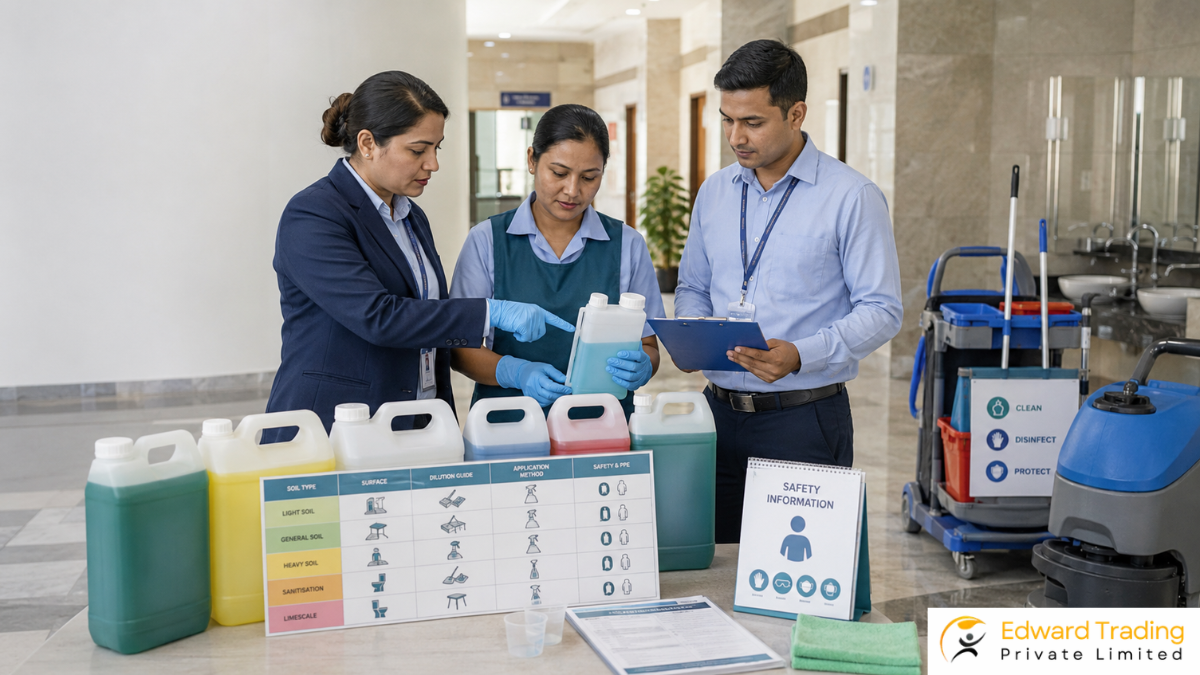
Cleaning Chemicals in Nepal: A Practical Selection Guide
When the selection of cleaners seems a simple enough decision, it becomes a different story when a floor becomes dull, washrooms don't smell like they should after they're mopped, or staff notice they need to use more cleaner to get the same result. These issues have been attributed to the chemical, but the solution could be in the wrong product, surface, soil or usage.
This guide provides a better process to choose Cleaning Chemicals in Nepal for the organizations. It is designed for hotels, hospitals, restaurants, schools, offices, retail, commercial buildings and cleaning contractors who require consistent results, no unnecessary surface damage or additional expenses.
What buyers are really looking for
A buyer may begin by asking for a floor cleaner or disinfectant. That's not frequently sufficient. There's a huge difference between cleaning a kitchen that's got oily deposits, a lobby that's got polished stone and a clinic that's got high-touch surfaces. Different products and methods may even be required by two different areas within the same building.
It's important for businesses to begin their commercial cleaning chemicals in Nepal with the job, not the brand or the container size. They should understand what is being removed, which surface is being cleaned, the frequency of the cleaning and whether the cleaning is for routine cleaning, degreasing, descaling, stain removal, or disinfection.
Organizations managing several departments can browse Edward Trading’s institutional supply solutions to understand the broader categories available before preparing a detailed enquiry. Exact products, pack sizes, documentation, and availability should still be confirmed directly.
Start with the cleaning task, not the label
Identify the soil
There are many different types of chemistry to deal with dust, food grease, soap film, mineral scale, beverage spills, body fluids, and old stains. An “all day” neutral cleaner might be adequate for light soil and not work for a heavy kitchen deposit. Similarly, a strong degreaser may not be necessary in a regular office cleaning situation. Be as specific as you can about your soil before requesting a soil product recommendation from a supplier.
Check the surface
Surface cleaning chemicals need to be compatible with surface that is under the dirt. The tolerances vary from ceramic tile to natural stone, grout to stainless steel, glass to laminate painted walls, sealed wood to fabric. A material that performs well on one surface might cause haze, discolor, corrode or cause permanent damage to another. Look for the directions on the label and the manufacturer of the surface on the product label, and test an unknown product in a hidden location when appropriate.
Define the result
Cleaning and disinfection are related but different tasks. Soil and impurities are removed by cleaning. Disinfection involves the use of product and/or process suitable for reducing specified microorganisms on a suitable surface. If the area is visibly dirty, it may not receive the desired effect from the disinfectant. Cleaning is sometimes a necessary first step. The buyer should know exactly what they want to achieve rather than use any chemical as a universal solution.
Consider the application method
The method matters too. A chemical used with a mop may require a different dilution from one used in a spray bottle, scrubber, or extraction machine. Staff also need realistic instructions for measuring, applying, rinsing, drying, and allowing contact time. If the process is too complicated for the working environment, consistency will suffer even when the product itself is suitable.
Buyers can explore Edward Trading’s hygiene and housekeeping solutions when reviewing cleaning products and equipment for institutional use. The final choice should be based on the actual task, surface, application method, and current product information.
Build a simple institutional cleaning program
Professional cleaning products work best as part of a planned system rather than a cupboard full of unrelated bottles. Institutional cleaning solutions should assign one suitable product and method to each recurring task. This makes training easier, reduces accidental misuse, and helps managers understand why a result is improving or getting worse.
A practical cleaning chart can record:
- Area, surface, and type of soil
- Product name and intended task
- Correct dilution and measuring method
- Application method and required contact time
- Rinsing, ventilation, and drying requirements
- Required personal protective equipment
- Cleaning frequency and responsible team
Keep this chart where supervisors and cleaning staff can use it. Update it whenever a product, surface, or procedure changes. A short briefing at the time of change can prevent months of inconsistent use.
How to compare products and quotations
Get quotations from suppliers on the same written requirement. Each quotation must contain details of the product, pack size, concentration, recommended dilution, use, quantity, delivery scope, validity of the quotation and commercial terms. If an alternative is suggested, the difference should be explained, rather than left to the understanding of the buyer that the products are the same.
Ask for the documents that are really appropriate to the product. This can include current label, technical data sheet, safety data sheet, dilution instructions, surface compatibility, and instructions for protective equipment. Ensure that all documents are specific to the same product being offered and not just the manufacturer's overall product line.
Use cleaning chemicals safely
The CDC’s environmental cleaning procedures provide useful background on task-specific cleaning, disinfectant use, contact time, and protective equipment in healthcare facilities. This resource should be treated as supporting guidance rather than Nepalese regulation. Organizations must also follow the product label, manufacturer instructions, workplace procedures, and any applicable local requirements.
Do not mix products unless the manufacturer has said it is ok. Mixtures of chemicals can pose risks of harm, cause loss of performance, or harm surfaces. Products must be stored in containers or properly labeled approved dispensing bottles. Secure and well-ventililated (where necessary) and organized storage. qualified to store incompatible products in different areas.
Look beyond the container price
A five litre container isn't necessarily cheaper than a one litre concentrate and a concentrate isn't necessarily a better value. Determine the amount of solution available from each pack, when diluted to the recommended strength. Then look at coverage, labour, dosing equipment, packaging waste, repeat cleaning and the risk of surface damage.
A frequently overlooked cost of overdosing is overdose. Can leave a residue, attract soil, require more rinses, and consume stock without adding to the outcome. It can also cause problems if it is under dosed as staff may have to re-clean the same area. If repeated work, costs per prepared litre or per standard task should be compared not price per container.
Plan delivery, training, and ongoing supply
Before ordering, confirm pack sizes, minimum quantities, current availability, lead time, delivery location, payment terms, and the process for reporting damaged or incorrect items. When products will be used across several sites, agree on how stock will be labelled, distributed, and reordered.
Training does not need to be lengthy, but it should be practical. Staff should be able to identify the correct product, measure it accurately, use the required protective equipment, and explain what they must never mix. Supervisors can review results through routine inspections, complaint records, consumption trends, and re-cleaning rates instead of simply increasing the dose when something goes wrong.
Why consider Edward Trading?
Edward Trading is located in Kathmandu and offers cleaning, hygiene, healthcare, surgical and hospital supplies categories to institutional buyers. It published process emphasizes the requirements understanding, recommending an appropriate fit, coordinating supply, and assisting repeat requirements. It is the buyer's responsibility to also ensure that the latest confirmation is always obtained for all products, claims, price and delivery promises.
Facility teams can review Edward Trading’s information as a Diversey and TASKI distributor in Nepal. When requesting a quotation, provide the facility type, surfaces, cleaning challenges, current method, estimated consumption, and delivery location so the discussion begins with a real operational need.
Conclusion
The first step in any sensible cleaning program is to observe. Determine the soil, safeguard the surface, decide the desired outcome and select a practice that staff can implement regularly. Use dilution, documentation, safety and cost in use (not the label or container price) to compare products.
Planning to purchase cleaning chemicals for a hospital, hotel, restaurant, office, school, or commercial facility? Contact Edward Trading to request a quotation and share your cleaning tasks, surfaces, current method, estimated quantity, delivery location, and expected
Frequently asked questions
What is the difference between cleaning and disinfecting?
Soil and impurities are removed from a surface by cleaning. Disinfection involves a proper chemical and process for reduction of specific microorganisms. Some activities do need to be cleaned prior to disinfecting.
How to determine the safety of a chemical for a surface?
Read the product label and surface manufacturer's instructions. If unsure and instructions permit, test in a small concealed area; confirm intended use, dilution, etc.
Are concentrated cleaning chemicals always cheaper?
No. The prepared volume, recommended dose, coverage, labour, wastage and re-cleaning rate. A concentrate is only worth its value if it is measured and used properly.
What information should I send when requesting a quotation?
Describe the facility, cleaning area, surface, soil, current process, application method, estimated quantity, delivery location, and required date. Also, discuss any documentation or training expectations as well.