Hospital Furniture
Hospital Furniture in Nepal: Selection Guide
A practical guide to selecting hospital furniture in Nepal, including beds, trolleys, examination furniture, storage, and patient-area planning.
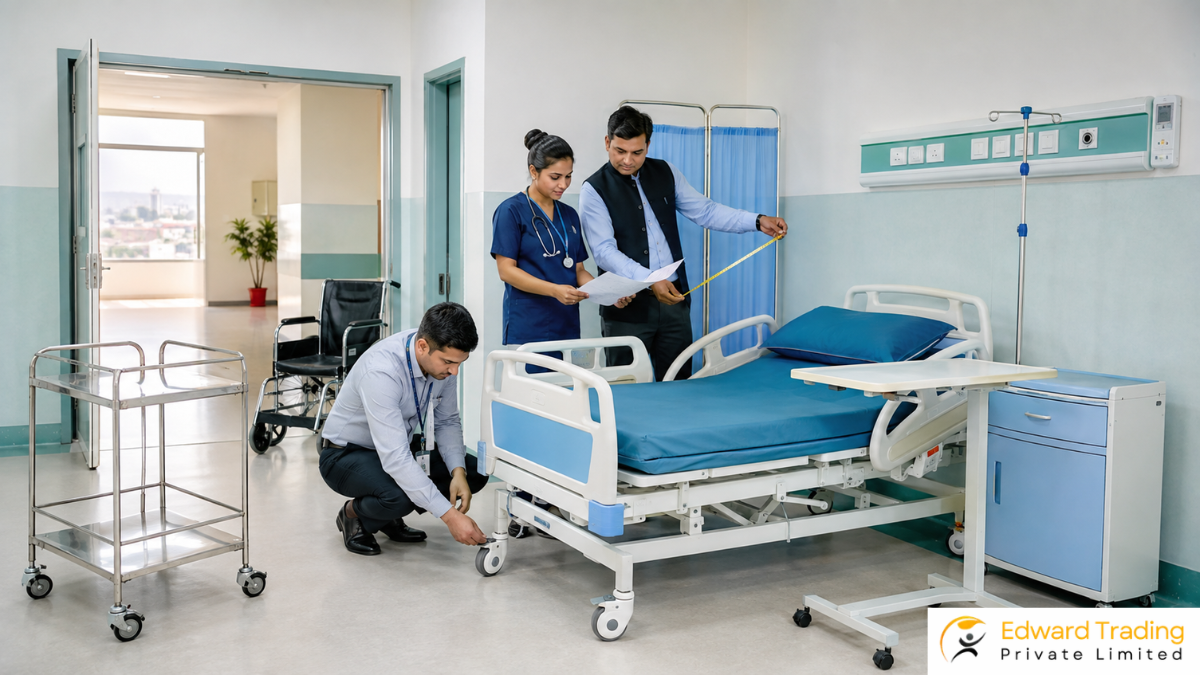
Hospital Furniture in Nepal: Selection Guide
Hospital furniture is used continuously by patients, nurses, attendants, and cleaning teams. It must fit the room, support safe movement, tolerate routine cleaning, and remain practical during daily care, not merely look suitable in a catalogue. This guide is intended for hospitals, clinics, nursing homes, architects, contractors, and purchasing departments. It will cover the solution area options, the queries to be asked, the cost considerations, and the support aspects that should be confirmed before requesting a quote from suppliers in Nepal.
Edward Trading supplies hospital furniture, healthcare products, surgical instruments, and institutional hygiene solutions for buyers in Nepal. Institutions should contact the company to confirm the exact product range, specifications, availability, and delivery terms.
What buyers mean when searching for Hospital Furniture in Nepal
Whereas there are many factors that an institutional buyer should consider while assessing a hospital furniture provider in Nepal, it is important to consider more than just the designs.
While seeking hospital furniture in Nepal, an institution could start with a product name, but the purchase is much broader. What is being purchased must suit the user, the facility, the workload, the operational technique, the location, documentation needs, budget, and time frame. A good purchase is one which is predictable from delivery through usage, monitoring, replenishment, and maintenance.
Edward Trading deals with hospitals, clinics, hotels, commercial buildings, schools, offices, contractors and many other institutional groups. It supplies products for healthcare, surgical instruments, hospital furniture, and hygiene and housekeeping. Institutions are advised to verify everything on every inquiry.
Buyers preparing requirements for several departments can browse Edward Trading’s healthcare and hospital supply solutions before creating their final procurement schedule.
Products and solution areas to consider
Beds and mattresses
While choosing the hospital beds in Nepal, it is important to take into account the target patient group, degree of care, size of the bed, safe working load, adjustability feature, side bars, wheels, braking systems, and the right mattress. At the same time, the chosen bed must meet the room layout requirements and be in compliance with the existing cleaning and patient transfer techniques in the facility.
Bedside and examination furniture
The furniture of patient rooms may consist of bedside lockers, overbed tables, patient chairs, stools, screens, and other complementary items. It is required that the mentioned equipment is designed to ensure good access for both the patients and the staff and guarantee privacy, safety during movement, ease of cleaning, and rational use of room space.
Movement and transfer
Stretchers, wheelchairs, and trolleys must have dimensions, manoeuvrability, brakes, handles, accessories, and compatibility with corridors, lifts, and ramps.
Storage and waiting areas
Cabinets, racks, benches, and seating should be planned for capacity, cleanability, user comfort, security, and traffic flow.
How to choose Hospital Furniture in Nepal
The selection of medical furniture should be made based on the specific department and use of the furniture. For instance, a piece of furniture that may be appropriate for general use in a waiting area may not be appropriate for the wards, examination areas, or other procedure areas.
Make a brief statement of requirements before requesting for quotations. This requirement should include the problem to be solved, the intended users, the location of use, the specification, the quantity, the existing product or method, the date needed, and any mandatory documentation. Where the requirements are for clinical care, safety, infection prevention, or laboratory quality, make sure the relevant technical user is involved.
- Patient beds and compatible mattresses
- Bedside locker and overbed tables
- Examination couches, stools, and screens
- Trolleys, stretchers, wheelchairs, and transfer aids
- Storage cabinets, racks, waiting seats, and stainless-steel furniture
Make sure suppliers identify any assumptions or alternatives made in their quotes. The quotation should identify the actual item being quoted, if applicable, the model or product code, configuration, pack size, quantity, units, inclusions, exclusions, delivery scope, validity, and commercial terms.
Specifications, documentation, and trust checks
Review documents that are relevant to the category rather than requesting an unfocused pile of certificates. These may include technical data, current labels or instructions, manufacturer information, safety data, warranty conditions, installation requirements, maintenance guidance, and quality documents. Confirm that the documents match the exact quoted product.
The World Health Organization’s guidance on improving quality in healthcare facilities highlights the importance of safe, reliable, and functional healthcare environments. Buyers should apply this principle when assessing furniture condition, accessibility, cleanability, placement, and suitability for patient care.
Do not make unsupported statements like “best”, “number one”, or “fully certified” where there is no proof provided. Edward Trading claims to have been founded in 2020, and its list of partners, as well as supply categories, can be found on their website. In case of a specific brand or regulated product, ask for the latest written confirmation.
What affects pricing and total cost?
Hospital furniture cost will depend on the material used, manufacture, size, adjustability, wheels and brake, accessories, mattress specifications, finish, quantity, transportation, assembly, and warranty. Evaluate the complete item and not just the name of the product.
Check also the validity of the quotation, tax considerations, terms of payment, delivery point, minimum quantity order, time, and procedure for goods that have been damaged, missing, or are non-conformity. Where there will be repeat orders, make sure you include consumption and ordering in your decision to ensure continuity.
When comparing, include all offers on the same sheet of evaluation. Indicate if the criteria are met, partly met, provided as alternatives, not met, or yet to be clarified. Separate the technical decision from the commercial cost until you have evaluated the alternatives.
Procurement, delivery, installation, and ongoing support
Measure the rooms, passageways, doors, lifts, turning points, and access to deliveries. On delivery, check the surface quality, welding, fixings, wheels, brakes, moving parts, dimensions, accessories, and quantity. Assign an asset number and maintenance instructions prior to operation.
On delivery, cross-check the consignment against the purchase order and packaging information. Check the quantity, identification, quality, accessories, documentation, and transportation requirements as applicable. Note any discrepancies before the product goes into normal use. Include contact information and warranty information with the purchasing documentation.
Common purchasing mistakes to avoid
- Checking dimensions only after delivery.
- Ignoring wheel, brake, rail, and adjustment details.
- Selecting finishes that are difficult to clean.
- Buying furniture without considering corridors, lifts, and door widths.
- Choosing on headline price without calculating cost in use or lifecycle cost.
- Publishing or approving claims that have not been verified for the exact product.
- Failing to confirm delivery, documentation, training, warranty, or repeat-supply expectations in writing.
Why consider Edward Trading?
Buyers can learn more about Edward Trading, its company background, and its healthcare supply focus before submitting an inquiry. Edward Trading is based in Kathmandu and presents healthcare, surgical, cleaning, hygiene, and hospital-related product categories for institutional buyers in Nepal.
Edward Trading’s partner page lists Diversey and TASKI, Medtech, Nulife, and AIZ & Co. Its website also provides a direct inquiry route where buyers can share organization details, product interest, quantity, specification, and timeline. These published details give buyers a useful starting point, while the exact product scope and commercial terms should be confirmed through a current quotation.
Conclusion: request a quotation for Hospital Furniture in Nepal
Choosing hospital furniture in Nepal should begin with a clear requirement and end with a documented comparison. Focus on suitability, specifications, evidence, current availability, delivery, support, and total cost. This approach helps institutions avoid unsuitable substitutions and build a more dependable supply plan.
Planning to purchase hospital beds, bedside furniture, examination couches, trolleys, storage units, or other medical furniture? Contact Edward Trading to request a quotation and provide the product types, dimensions, required features, quantities, delivery location, and expected timeline.
Frequently asked questions
What hospital furniture is commonly required?
Common furniture that hospital requires include patient beds, mattresses, bedside lockers, overbed tables, examination couches, stools, screens, trolleys, stretchers, wheelchairs, cabinets, racks, and waiting seats.
How much does an electric ICU bed cost in Nepal?
In Nepal, the price of an electric ICU bed varies between NPR 65,000 and above NPR 12,000,000 (12 Lakhs) based on the number of motorized functions, brand and the features.
What are the requirements for a 100 bed hospital in Nepal?
What should be checked at delivery?
At the delivery, the configuration, dimensions, quantity, finish, stability, movement, brakes, accessories, mattress, documentation, and damage should be verified.