Laundry Chemicals
Laundry Chemicals in Nepal: Institutional Guide
Select laundry chemicals in Nepal for hotels, hospitals, and institutions using fabric type, soil level, water quality, dosing, safety, and wash results.
Laundry Chemicals in Nepal: Institutional Guide
Cleaning laundry in an institution like a hospital, commercial laundry or hotel is more than just selecting a detergent and washing. The result depends on the type of fabric, the soil level, the quality of the water, the machine capacity, the temperature, the concentration of the chemicals, the method of dosing, and the rinsing performance. A proper programme should thoroughly clean without causing damage to the fabric, re-wash or chemical waste.
This guide is designed for the procurement team, housekeeping managers and laundry supervisors, hospital support team, and other institutional buyers doing a comparison of laundry chemicals in Nepal. The objective is straightforward: "to get the right information about the laundry, compare it on the same terms, and select a supply strategy that can be sustained beyond the first order.
What to look for when buying laundry chemicals in Nepal
The starting point for a good laundry chemical programme is not the label on the chemical but the process. Prior to requesting a quotation, determine the types of linen being laundered, the average linen size, the primary problems with the linen, the water temperature available, the water hardness (if known), the type of machine used, the length of the cycle, and the results achieved. This information should guide a supplier in suggesting a viable combination rather than a product alone.
It's also important to distinguish between regular clothing and special situations. Cleaning requirements for hospital linen, restaurant napkins, uniforms, towels and hotel linen can vary. Not all programs are suitable for all groups.
Commercial laundry chemicals Nepal: what should be compared?
While purchasing commercial laundry chemicals in Nepal buyers should not only consider the price of the single container. Verify the recommended dosage, pack size, expected consumption, compatibility with the washing process, storage instructions and if the supplier can explain how it should be used.
It's also useful to consider cost per litre or kilogram of dry linen, or cost per standard wash, in larger facilities, rather than cost per litre or kilogram of chemical. The lower cost product may be too costly if it needs to be dosed more heavily, applies to more fabric or leads to early fabric replacement.
Hotel laundry detergent and guest-facing results
Hotel laundry has a practical challenge: the linen has to look and feel clean while moving through a high-volume routine. A hotel laundry detergent should therefore be evaluated against the actual fabrics and wash programme, not simply fragrance or the appearance of one sample load.
Hotels should consider towels, bed linen, uniforms, restaurant linen, and coloured fabrics separately where necessary. Consistent dosing and repeatable wash formulas are particularly important when many loads are processed each day. If the facility uses automatic dosing, confirm the equipment, calibration, maintenance responsibilities, and chemical compatibility before implementation.
Hospital laundry chemicals: safety and process control
Hospital laundry chemicals must be given special consideration since the laundry system is in place as part of a larger hygiene and infection control system. Handling, containment, washing, drying and clean linen storage are all critical to the chemical selection itself, as healthcare textiles can be bed linen, towels, gowns and uniforms.
Do not use a chemical product to replace appropriate laundry procedures for healthcare facilities. The CDC guidance for managing linen and laundry covers the following factors: time and temperature, mechanical action, water quality, load volume, soiling, equipment, and safe handling practices.
The wash formula used will depend on the specific requirements of the facility, instructions for fabric care, guidance by the equipment manufacturer, and appropriate safety precautions. Documentation of the product must also be verified with the product to be quoted.
Institutional laundry solutions: build the programme around the facility
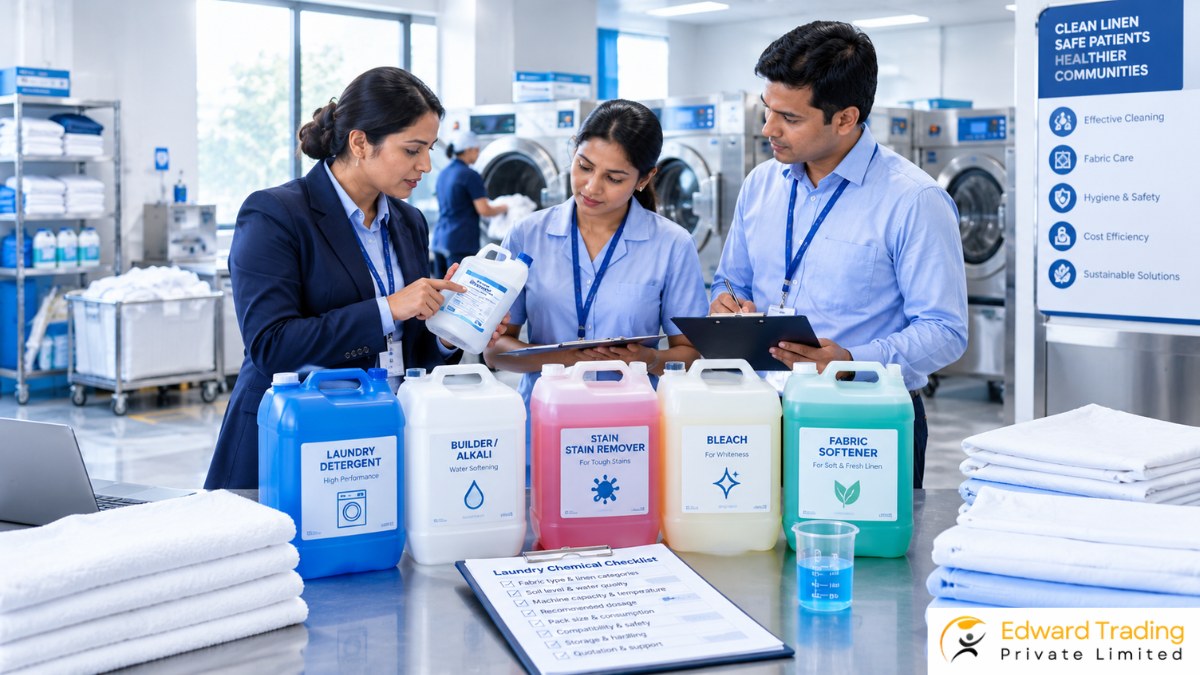
Institutional laundry solutions are most useful when they solve the complete workflow rather than supplying disconnected chemicals. Depending on the facility, a programme may include a main detergent, builder or alkali, de-stainer or bleach where appropriate, neutralizer or sour, and a finishing product such as a softener.
Not every facility needs every component. The right combination depends on the fabric, soil, water, temperature, machine, and desired finish. For that reason, ask the supplier to explain the role of each product, its recommended use concentration, and any important compatibility or handling requirements.
A practical checklist before requesting a quotation
- List the main linen categories and approximate monthly or weekly volume.
- Record typical load weight, machine capacity, wash temperature, and cycle time.
- Describe the main soil or stain problems instead of simply asking for a stronger chemical.
- Note whether water hardness or other water-quality issues are known.
- State whether dosing is manual or automatic.
- Ask for technical information, current labels or instructions, safety data, pack sizes, and recommended dosage.
- Request the quotation with product name or code, quantity, unit, delivery scope, validity, and commercial terms.
- Confirm lead time, repeat-supply arrangements, training or dosing support, and the process for damaged or non-conforming goods.
How to compare laundry chemical cost
Price should be assessed in use. For a meaningful comparison, calculate the expected chemical cost per kilogram of dry linen or per standard load. Then consider the wider operating picture: water, heating, electricity, labour, dosing equipment, rewash, rejected linen, and fabric replacement.
A quotation that looks inexpensive on the first page may not be the best value if the product requires a high dose or performs inconsistently. Ask suppliers to state their assumptions clearly so different offers can be compared on the same basis.
Documentation, storage, and ongoing support
Before approving a product, review the documents that actually matter for the purchase. Depending on the chemical and application, these can include technical data, product instructions, safety data, manufacturer information, storage requirements, warranty or support terms, and dosing guidance. Make sure the documentation corresponds to the exact product being supplied.
Storage also deserves attention. Keep chemicals in the conditions specified by the manufacturer, use clear labels, and make sure staff know the relevant handling precautions. For automatic dosing systems, establish who is responsible for installation, calibration, maintenance, troubleshooting, and replenishment.
At delivery, compare the shipment with the purchase order. Check product identity, quantity, packaging condition, documents, and any lot or batch information that is relevant to your process. Record discrepancies before the products enter routine use.
Common mistakes to avoid
- Using the same wash formula for every type of linen.
- Choosing only by container price instead of cost in use.
- Increasing chemical dose when the underlying problem is sorting, loading, temperature, or water quality.
- Ignoring fabric-care instructions.
- Changing several process variables at once when troubleshooting.
- Failing to document the agreed dosage and wash formula.
- Assuming a product is suitable for healthcare use without checking its documentation and intended application.
- Leaving delivery, training, support, or repeat-supply expectations unclear.
Why consider Edward Trading?
Edward Trading Pvt. Ltd. is based in Kathmandu and presents healthcare, hygiene, cleaning, surgical, and hospital-related product categories for institutional buyers in Nepal. For buyers comparing laundry chemicals in Nepal, the useful starting point is to share the facility's actual requirements rather than asking for a generic product.
You can review Edward Trading's hygiene and housekeeping solutions and compare the available categories with your laundry needs. You can also review Edward Trading's partner companies before requesting a current quotation.
Availability, product specifications, pricing, and commercial terms can change, so these details should be confirmed directly for the current requirement.
Conclusion: choosing laundry chemicals in Nepal
The most cost-efficient laundry chemical purchase isn't always the one that has the cheapest unit cost. It's the one that suits the fabrics and soils at the facility, equipment, water, wash programme, safety needs and anticipated workload, and is available on a consistent basis.
Before requesting prices for a hotel, hospital, commercial laundry, clinic, school, restaurant or other institution, draw up your process first. Now make comparisons on the same basis for dosage, documentation, cost in use, delivery, support and repeat supply expectations.
Looking for your answer? Ask Edward Trading for a quote and provide the type of linen, volume, machine specifications, delivery address and delivery date. Edward Trading can be seen for a general overview of product and solution lines.
You can also visit Edward Trading to review the broader product and solution categories.
Frequently asked questions
Which chemicals are commonly used in institutional laundry?
A programme may include detergent, builder or alkali, destainer or bleach, neutraliser or sour, and a finishing product. The exact combination depends on the fabric, soil, water, machine, and wash programme.
Can one laundry formula be used for every linen type?
Not always. White cotton, coloured fabrics, towels, kitchen linen, uniforms, delicate items, and healthcare textiles may need different programmes or controls.
Why does water quality matter?
Water hardness and other water conditions can influence detergent performance, scale, rinsing, and the amount of chemistry required. If performance changes unexpectedly, check water conditions before simply increasing the dose.
How should a buyer compare laundry chemical prices?
Compare expected cost per standard load or kilogram of dry linen, then consider rewash, fabric damage, water, energy, labour, and other operating costs. This gives a more useful picture than comparing container prices alone.