Medical Equipment
Medical Equipment Supplier in Nepal
Looking for a medical equipment supplier in Nepal? Learn how hospitals and clinics can compare quality, documentation, delivery, and supply support.
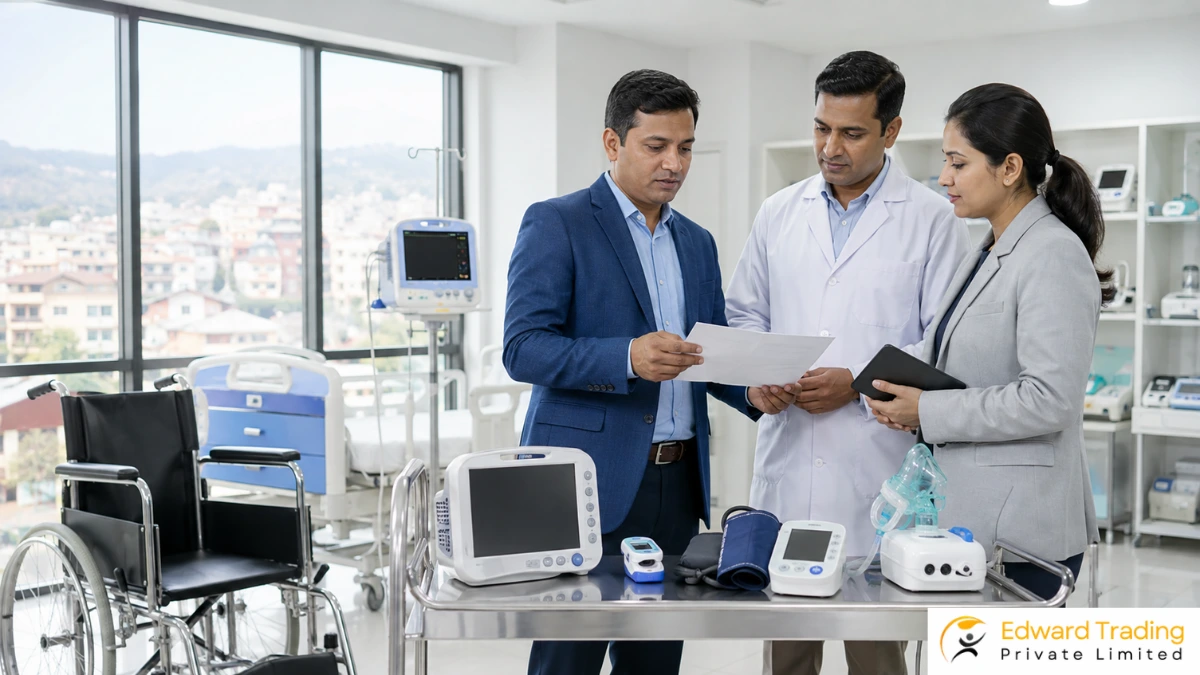
Medical Equipment Supplier in Nepal: Buyer’s Guide
Purchasing medical equipment is no simple matter of comparing prices. The appearance of a suitable monitor, diagnostic device, trolley or home care item may seem appropriate on paper, but it is only when the specification is matched, documented, planned for delivery and there is reliable communication following the order that the actual value is established.
The purpose of the guide is to be helpful to hospital owners, procurement staff, clinics, diagnostic centres and healthcare project managers. It gives you information on the choices of solutions, the questions to ask, the variables to consider and support to verify before asking for a quotation from a medical equipment supplier in Nepal.
What buyers mean when searching for Medical Equipment Supplier in Nepal
The search for a medical equipment supplier in Nepal can start with a product name, but the decision for institutional procurement is more extensive. The product selected must be user-friendly, facility appropriate, match the workload, meet the operating procedure, accommodate site requirements, meet documentation requirements, be affordable, and meet supply time requirements. A good purchase is one that can be received, used, monitored, replenished and supported without unnecessary surprises.
Edward Trading works with hospitals, clinics, hotels, commercial buildings, schools, offices, contractors, and other institutional teams. Institutional buyers can explore Edward Trading’s healthcare product range, including products intended for hospitals, clinics, home healthcare, and routine patient monitoring. Buyers with requirements across several categories can also explore Edward Trading’s healthcare and institutional solutions before preparing their product list.
Products and solution areas to consider
1. Diagnostic and monitoring equipment
Items used to support examination, measurement, monitoring, and clinical decision-making must be matched to the intended service, expected workload, and required performance.
2. Patient-care and home-care products
Facilities may require products for mobility, respiratory support, routine observation, ward care, or care outside the hospital. Accessories and user instructions matter as much as the main item.
3. Hospital and clinical support items
Trolleys, transfer products, examination items, and other supporting equipment influence workflow, safety, and staff efficiency. Hospitals preparing operation theatres or procedure rooms may also need to review the available surgical instruments and clinical products.
How to choose Medical Equipment Supplier in Nepal
Make a short requirement prior to asking for prices. State problem to solve, intended users, location, specification, quantity, existing product or method, required date and any required documentation. If the requirement has an impact on clinical care, safety, infection prevention or laboratory quality, consult the appropriate technical users before the approval.
- Intended clinical use and expected patient volume
- Technical specifications, accessories, and compatible consumables
- Manufacturer information, product documentation, and warranty terms
- Installation, user orientation, and after-sales expectations
- Delivery location, access constraints, and required timeline
Inquire from suppliers for any assumption or proposed alternative. A quotation should clearly demonstrate the exact item, model or product code, configuration, pack size, quantity, unit, inclusions/exclusions, delivery scope, validity and commercial terms. This ensures a fair comparison and avoids the situation of two products being perceived as the same product.
Specifications, documentation, and trust checks
Examine paperwork that falls under the category, not an open-ended collection of paperwork. These can contain technical data, up-to-date labels and instructions, manufacturer information, safety data, warranty conditions, installation instructions, maintenance instructions and quality documents. Buyers can review the partner companies represented by Edward Trading when researching available brands, product categories, and manufacturer relationships.
The World Health Organization’s guide to technical specifications for medical devices can help procurement teams understand the types of technical information that should be considered when purchasing medical equipment. Buyers must also confirm any applicable requirements in Nepal and check the documentation for the exact product being offered.
Do not make statements like “best,” “number one” or “fully certified” unless backed up by evidence. Edward Trading says that it was founded in 2020 and lists its partner companies and supply categories on its website. If it is a brand item or regulated, ask them for current written confirmation rather than an old post, catalogue picture or verbal confirmation.
What affects pricing and total cost?
The prices of medical equipment vary depending on the type, performance, accessories, consumables, warranty, scope of installation, delivery location, and order quantity. It may be more economical to pay a higher price for an equipment quote along with the accessories required for training.
Also check the validity of the quotation, tax, payment, delivery, minimum order, lead time and what to do with damaged, missing or non-conforming items. If the purchase is to be repeated, discuss consumption and reorder planning in such a way that the decision will facilitate continuity and not an urgent purchase.
To make a fair comparison, list each offer on the same evaluation sheet. Indicate if each requirement is met, partially met, an alternative, not included, or yet to be clarified. Do not mix up the business and the technical aspects of the total until the options have been understood.
Procurement, delivery, installation, and ongoing support
For equipment that requires installation, confirm site readiness, commissioning responsibilities, acceptance checks, user orientation, warranty coverage, routine maintenance, and the escalation path for faults. Ask for these items in writing before the order.
At delivery, compare the consignment with the purchase order and packing information. Check quantity, identity, condition, accessories, documents, lot or serial details where relevant, and any transport requirements. Record discrepancies before the product enters routine use. Keep responsible contacts and warranty or complaint procedures with the procurement record.
Common purchasing mistakes to avoid
- Requesting a quotation without a complete specification.
- Choosing only by the lowest initial price.
- Forgetting recurring consumables and accessories.
- Assuming every model is immediately available in Nepal.
- Choosing on headline price without calculating cost in use or lifecycle cost.
- Publishing or approving claims that have not been verified for the exact product.
- Failing to confirm delivery, documentation, training, warranty, or repeat-supply expectations in writing.
Why consider Edward Trading?
Edward Trading Pvt. Ltd. is based in Kathmandu and supplies healthcare, hygiene, cleaning, surgical, and hospital-related product categories for institutional buyers in Nepal. The company describes a practical workflow of understanding requirements, recommending a fit, coordinating supply, and supporting continuity.
Edward Trading’s partner page lists Diversey and TASKI, Medtech, Nulife, and AIZ & Co. Its website also provides a direct inquiry route where buyers can share organization details, product interest, quantity, specification, and timeline. These published details give buyers a useful starting point, while the exact product scope and commercial terms should be confirmed through a current quotation.
Conclusion: Request a quotation for Medical Equipment Supplier in Nepal
Choosing medical equipment supplier in Nepal should begin with a clear requirement and end with a documented comparison. Focus on suitability, specifications, evidence, current availability, delivery, support, and total cost. This approach helps institutions avoid unsuitable substitutions and build a more dependable supply plan.
Planning to purchase medical equipment for a hospital, clinic, laboratory, or healthcare project? Contact Edward Trading for a medical equipment quotation and share your specifications, required quantity, delivery location, and expected timeline.
Frequently asked questions
What are the top 10 medicine companies in Nepal?
The top pharmaceuticals in Nepal consist of both domestic firms of considerable size and big multinational firms. The prominent players in the market in terms of market share and presence are National Healthcare, Quest Pharmaceuticals, and Nepal Pharmaceutical Laboratories.
How should a hospital compare medical equipment suppliers?
Hospital should compare technical compliance, documentation, included accessories, warranty, delivery, installation, training, maintenance expectations, and total lifecycle cost, not price alone.
Is installation and staff training always included?
No. The scope varies by product and quotation. Buyers should ask whether installation, commissioning, user orientation, and technical training are included or separately chargeable.
What information is needed for a quotation?
Provide the intended use, specification, preferred model or acceptable alternative, quantity, delivery site, required date, utilities, and documentation expectations.